
"We just need a quick translation into a few languages."
John Doe-Loc
VP of Production
If you've ever said this - or heard this from your own team - welcome to the right place. This post is for you.
Look, there's no such thing as a quick translation into a few languages. There's a process you own and understand, and a process you don't want to bother digging deeper into. And the gap between those two, especially when it comes to localization? It costs companies a lot of money. Just rarely on a line item anyone can point to.
First, let's focus on the actual need: translation or localization?
Translation and localization are not the same thing.
Translation is converting words from language A to language B. Localization is making your product, your content, and your entire brand feel like it was built for the target market - not just roughly "converted", adapted for it. The first one is a task. The other one is a process. A process with somewhere between 10 and 15 steps, depending on what you're localizing, involving several different specialist roles and at least one - mildly, or heavily complex - system that actually keeps it all together.
The reason this distinction matters: when companies say "we just need a translation," they almost always mean localization. They just don't know it yet. And they find out at the wrong moment - when the layout is broken, the files are missing, the colors are off, the deadline was last Tuesday, and somehow the Bulgarian user guide was shipped with Serbian text. (Well they're both Cyrillic, in the end. Close enough, right? No. Not really. Super embarrassing. On a good day.)
But AI takes care of this now
Partially. AI can translate. Reasonably well, in many cases. And it's getting better every day, no doubt.
But here's the thing: the translation itself was never the most expensive part.
What's expensive is everything around it. Managing the files. Maintaining consistent terminology across 20-something languages. Keeping your brand voice from drifting across vendors. Making sure your DTP doesn't break on page 34 of the German manual because, yes, German words (and Bulgarian words, oh boy) are longer and they will cause layout issues, every single time, forever. And making sure the right file lands in the right place for the right market before your launch or shipping date - not after.
Translation might be free, some would argue. But regulatory compliance, on-time delivery, brand consistency, and not having your Marketing Manager crying at her desk at 11pm, well that part is not. And that is the part that matters when it comes to money.
But let's break it down a little.
What "just a few languages" actually looks like
Let's make this one a real life example. Theoretically, you only need a couple languages, for couple of User Guides from your portfolio. Say you're launching a new product portfolio: five user guides, roughly 70 pages each, only nine languages (just a small chunk of all the EU languages - which, btw. all require target-market translation if you are planning to sell in European Union).
Here's how it looks like from our side - what most companies call "we just need a translation":
Pre-production
Localization
Post-production
That's the process for this User Guide scenario. Every time. For every language. Whether you're aware of it happening or not. Whether you call it "just a translation" or not. It's never "just a translation".
And behind that process, there's a technical layer that's equally important, and equally messy. Especially when it's not set up right. What system does your content live in? What triggers the localization workflow? Does your CMS (Content management System) talk to your TMS (Translation Management System)? Do you even have a TMS at all? Why would you? But then does your TMS "talk back" when it's done?
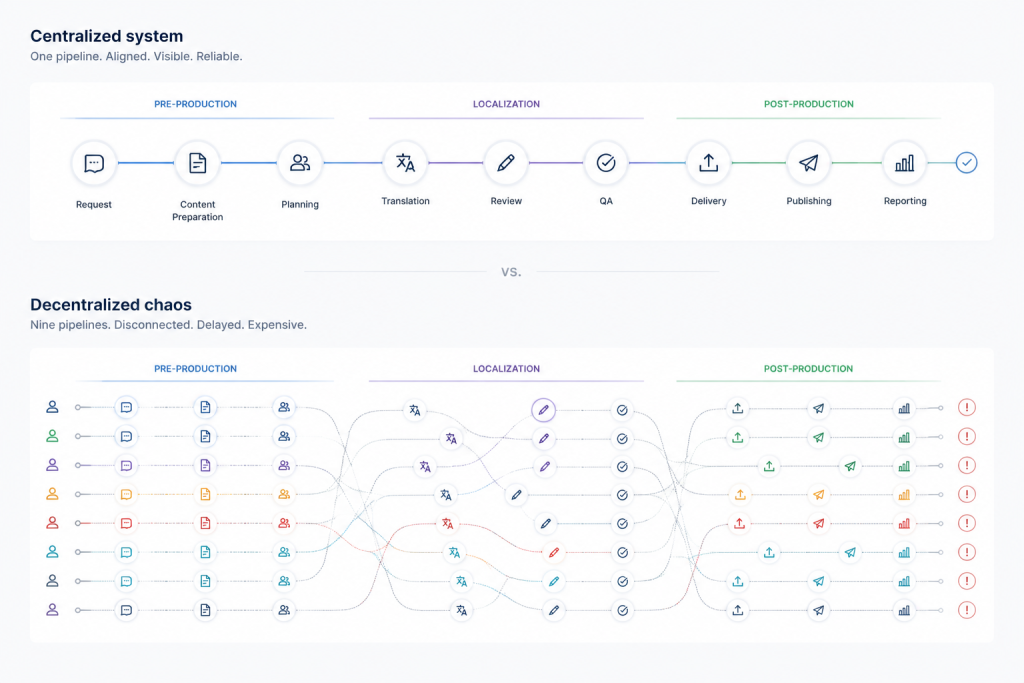
Most companies are running this on email, shared folders, and a huge amount of hope. The whole world is, and can be, run on Excel and PowerPoint. But that doesn't mean it's the right way.
The right setup has connectors, automations, and clear handoffs between tools. Then the content flows in, gets processed, and lands back where it belongs without anyone having to chase it. But it's a whole new conversation when it comes to that.
The Problem Before The Problem:
Nobody invited localization to the design meeting
If this was a TV Show, we're at episode when the protagonist remembers something from the past.
It's something most companies discover too late: the cost and complexity of localization isn't just about how you manage the process. It's also about how you started, how you created the content in the first place.
Let's keep our User Guide localization example here. Take file formats. Many design teams work in Adobe something (InDesign, Illustrator).
The good news: a proper localization partner can work directly with these files - extract the text, translate it, put it back in. No copy-paste, no reformatting from scratch.
The bad news: this only works cleanly if the files were actually built with localization in mind. Text embedded in images? Flattened layers? Fonts that don't support Eastern European, or right-to-left characters?
Now you have a problem that adds cost and time to every single project - and it could have been avoided at the design stage.
The worst news: many companies are unaware of this possibility, and are creating DIY workarounds, which technically means the text that was supposed to be left alone, ends up in Excel sheet, with columns representing different languages. Or in Word file, one per User Guide, per language. Randomly named. Chaos? Nah, what do you mean? Right? Wrong. This is the very definition on how not to treat your content, unless you just want more work for everybody in your team (and yes, they are already in nick of time).
The Good News 2, aka The Solution: find a good, professional localization partner, and ask them if they can work with XY files. You'll be amazed.
A Software Localization Nightmare
Let's say you either have a webshop, or a mobile app for your product. Welcome to the world of Chaos, Part II.
And here, it really becomes visible why would you need a good Localization Partner company sitting with your developers, explaining them that there are things they need to think of at the coding level:
Number formats. 1,000.00 in English is 1.000,00 in German and 1 000,00 in French. Hardcoded number formats mean you've got a bug in every language.
Plural forms. English has two: singular and plural. Polish and Russian need four plural categories in software. Croatian needs three. Arabic needs six. Slovenian has a dual category - a separate grammatical form for exactly two of something (yes, really) - and four plural categories in CLDR. If your software assumes there are only two options, you're going to get grammatically strange sentences in a lot of markets.
Ok, but "is this really End of the World?" you might ask. Probably not. But if you are selling a premium product, with sloppy language (or numbers), that breaks trust, and hurts your conversion. Yes. Really.
Gender and grammatical cases. French, German, Spanish and plenty of others have grammatical gender. Russian, Czech, Polish have complex case systems with rules, exceptions, and exceptions to the exceptions. Sentence structures that work perfectly in English fall apart when you try to adapt them word for word.
Here's an English vs Serbian example, very simple to understand.
Software developers think in patterns, in reusable code (I love it too), and in architecture. Let's say we stick with the fact that you either have a webshop or an app. This is the string:
"Remove this [item_name]."
This works in English very well, you just replace [item_name] with whatever, and it works perfectly. For example:
In Serbian, there are cases. Seven of them. And they define the form of the word. In our example, you'd need to use Accusative case, which means that: the term for "message", which is "poruka" suddenly becomse "poruku". Same for "user" = "korisnik", but it becomes "korisnika" ... etc.
And we didn't even start to get into the gender mess here...
The problem isn't that there are no workarounds, usually there are. The problem is that they are extremely expensive, might sound strange or sloppy, and again, they destroy trust, and create awkward moments of "am I even at the right brand here"?
Companies that get this right involve their localization partner (or at minimum a localization-aware consultant) at the content creation and product development stage. Not as an afterthought. Not after the Illustrator files are locked and the app strings are already live. Before.
And here's the premium product angle: if you're selling a €5,000 piece of equipment, language quality is part of the product. A broken sentence in the user guide, an awkward label in the interface, a brochure that reads like it was machine-translated in 2019... unfortunately that actively damages the premium perception you spent years building. Nobody buys a €5,000 gadget from a company that couldn't be bothered to get the language right.
Selling a €20 phone case? Your customers might forgive a rough translation.
Selling premium machinery, medical devices, industrial equipment, or high-end consumer electronics? You don't get that pass. The language is part of the product. It's best to treat it like one.
The table nobody puts in front of the CFO
Here's where it gets interesting. Many believe that doing different language requires a lot of different vendors. So they don't do this with one vendor and a clear process. They do it with many, maybe freelancers, or boutique agencies, then external or in-house DTP specialist, in best case with an internal person coordinating the mess. Worst case the Marketing Manager get's this job.
Let's stick to our example and say you need localization into 9 languages. We won't go into all the details, but here's a nice little comparison what that actually looks like in both time, cost, human-involvement and headache:
Partial Localization Lifecycle With Many vs. One Dedicated Partner
TASK | MANY VENDORS INVOLVED | ONE STRATEGIC PARTNER |
|---|---|---|
DTP Setup | Multiply by number of companies or freelancers (9x the cost) | Build the template or process once, use it for all languages |
Cross-language DTP error detection | Zero - every person involved will have to pay extra attention and notice the same error. Client side PM might be able to inform others in time, or not. | Information is shared on the fly, all the people required are immediately informed. |
File delivery & archiving | Complete chaos, half in emails, half in uploads, across systems, tracking impossible, naming convention non existent. | One place, one delivery, one structure (and yes, Your structure) |
Translation / Revision | Many workflows, many players, many quality standards | Agreed upon, unified process that is followed from A to Z. |
Audit | A separate chaos on its own, chasing all the parties involved, after several months of being silent. | One contact, one e-mail or phone call. |
Project Management | 9 separate onboardings, contracts, briefings, and at least 9 times answering the same question | One dedicated PM contact, or Account Manager with good knowledge of your Brand and your needs. |
Risk Mitigation | High risk if there are no well established backups, and failsafe processes (what if someone gets sick) | Lower risk as there is one team, and one point of accountability |
Cost and ROI | Initial cost lower, huge overhead and timing issues if there is no dedicated Localization Manager | Initial cost higher, zero overhead. Overall much better ROI. |
Hidden Costs that Don't Make it to Your Spreadsheet
Here's the part that doesn't show up in a translation invoice but absolutely shows up in your company's performance.
A lot of small and mid-sized companies don't have a dedicated Localization Manager. What they have is a Marketing Manager, a Communications Director, or a Product Owner who got handed "this translation (localization) thing" somewhere along the way. Usually because they seemed organized or because they speak a second language (which has nothing to do with it, right?), or because there simply is nobody else who would do it.
And then what happens?
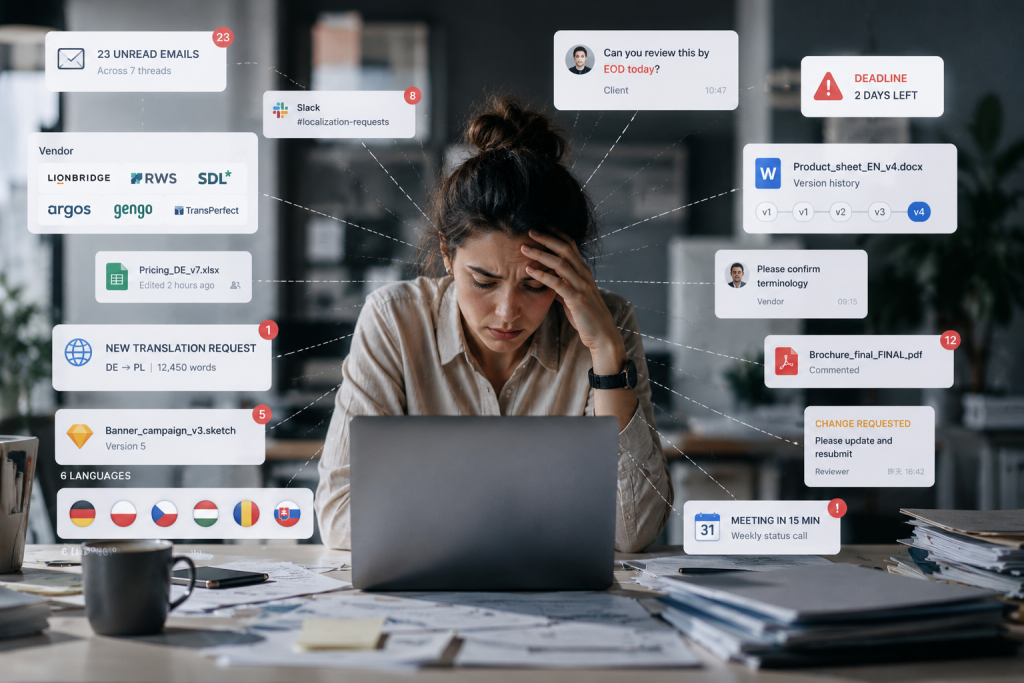
A person who was hired to run marketing campaigns, or manage product launches, or handle communications strategy, is now spending 40% of their time coordinating vendors, chasing file versions, resolving DTP conflicts, explaining to six different freelancers what your brand voice is, and apologizing to the Sales team for why the French catalog isn't ready yet.
Meanwhile: their actual job is not getting done. Priorities get reshuffled. Campaigns get delayed. Launches slip.
The C-level manager looks at the numbers, scratches their head, and wonders why the European rollout underperformed. Nobody connects it to the localization bottleneck, because nobody was tracking it. It just looked like "things took longer than expected."
This is the real cost of decentralized localization. Not the line items. The organizational drag.
Cost center or revenue driver?
(Spoiler: your Sales team already knows the answer)
Here's a conversation that happens in almost every company doing international business:
CFO looks at the localization budget and sees a cost center. "Why does this cost so much? Can we find a cheaper way?"
Sales team looks at the same budget and sees a revenue enabler. "If we don't have the French catalog, we can't sell in France. If the German manual isn't right, German distributors won't carry it."
Both are right. The question is which lens you use when making decisions.
And there's a practical angle to this that goes beyond preference: in the European Union, having your product materials in the official language of the country you're selling in isn't optional. It's a legal requirement. Not just labels. Not just the basics. The whole thing. So the CFO who cuts the localization budget isn't saving money - they're creating regulatory risk and leaving markets closed.
The companies that figured this out have stopped treating localization as an afterthought. They built a process around it. They're the ones expanding faster, launching cleaner, and not reprinting 10,000 manuals because someone shipped the wrong language.
So what does the right setup actually look like?
There's no single answer that fits every company, but here are the three models that in our opinion work quite well:
In-house localization team: makes sense at scale (30+ languages, continuous content volume). You own the process, you own the TMs, you have full control. High fixed cost, but justified if the volume is there. We're talking huge volume here.
External localization partner: depending on size there would be one, or max two trusted partner(s) who handles everything: vendor management, TMS, DTP, QA, delivery. Your team stays focused on their actual jobs. Works well for companies in growth phase or those without the volume to justify a full in-house setup.
Hybrid: a Localization Manager (or small team) on your side owns the strategy: priorities, brand standards, stakeholder communication, KPIs. Maintains glossaries, owns the infrastructure. And an external partner handles the execution. This is often the best of both worlds, because you have internal ownership without the overhead of building a full team from scratch.
What doesn't work
Everybody doing a small part of it, with no single owner, all coordinated through email and shared folders, using whoever is cheapest this quarter. That is possible if you are going to one market. But on scale? It will bleed you out.
The system that works for 3 languages needs to still work for 25. That's the real test.
The bottom line
Localization done well is invisible. Launches happen on time, manuals are correct, websites feel local, customers buy.
Localization done badly is very visible. Wrong text, broken layouts, delayed launches, frustrated distributors, regulatory headaches, and a Marketing Manager who is very, very tired.
The difference between those two outcomes is almost never the translation itself. It's the process, the ownership, and whether someone actually orchestrated the whole thing, or just hoped the parts would assemble themselves.
They won't.
Interested in understanding what your current localization setup is actually costing you? We're happy to walk through it.
TL;DR - Quick Questions and Answers
One, or if you are a bigger company, max two good localization partners will win on almost every measurable dimension: cost per project, consistency, turnaround, accountability, you name it. Multiple vendors (3+) make sense only at very high volume across highly specialized and possibly rare language pairs.
For most companies doing 5-30 languages, splitting the work multiplies your expenses and your problems, not your results.
For internal drafts and low-stakes content, often yes. For product documentation, user guides, regulatory materials, or anything customer-facing at a premium price point, AI might be able to handle the words, but not the process around them, nor the subject-matter expert revision step, which is necessary in order to de-risk your content from AI slop.
Note that file management, DTP, cross-language QA, and compliance don't get cheaper because translation did. If AI did anything, it made the steps more complex, and a proper partner who can handle that is worth its weight in gold.
Centralization is the only approach that holds up at scale. At 3 languages, a fragmented setup is annoying. At 15 or 30, it breaks completely. costs multiply, quality drifts, and someone on your team ends up spending most of their week managing vendors instead of doing their job.
What works at scale: a proper TMS that all content flows through, a single partner with full visibility across all languages, and one internal owner who sets priorities rather than chases status updates. The companies handling 30+ languages without chaos aren't doing more, they built a system that absorbs volume without adding overhead.
While on the surface it seems like "just a translation", under the hood is involves somewhere between 10 and 15 steps depending on content type and complexity.
Steps like file analysis, TMS setup, terminology management, translation, revision, localization engineering, DTP, layout review, and delivery, they are all part of it.
Always ask for a proper quote, and budget internally for the whole process to avoid being surprised. Find a reliable partner who owns the process and possibly integrates with your own ecosystem and tech-stack.
Depends on volume. Under 20 languages with irregular release cycles, a reliable external partner covers everything. Once localization touches multiple internal teams daily - such as product, marketing, legal, support - then an in-house owner who manages the relationship (not the vendors) starts making sense. The hybrid model often works best: internal ownership, external execution. With more than 40 languages at stake, it is also better to have someone in-house who owns the whole localization process, and can talk to stakeholders and C-Level managers.
Most of them.
From InDesign, Illustrator, Photoshop, Figma, Word, Excel, HTML, XML, to JSON, software strings, subtitle files, everything. Tha industry standar is the inter-exchangeable XLIFF format that 99% of the TMS systems recognize and can handle.
A proper localization partner works directly with your source files, extracts the text, and puts it back in. No copy paste necessary.
Where things break is when files are built without localization in mind: text "burned" into images, flattened layers, hardcoded strings in your software code, or DIY webpages that are not designed to be localized in the first place. That is even more reason, why you will be better of asking for professionals to look at it.